Support Local Charities Retro SVG Graphics for Crafts
As a graphic designer who’s built brand identities for handmade businesses, launched seasonal campaigns for local boutiques, and crafted packaging for Etsy sellers over the past 12 years, I recently evaluated Support Local Charities Retro SVG Design for a real client project: a limited-edition holiday collection supporting three neighborhood nonprofits. My goal wasn’t just to find “cute clipart”—it was to source a commercial design asset that could anchor visual storytelling while feeling authentic, warm, and intentionally nostalgic—not kitschy or generic.
A First Impression That Lands With Purpose
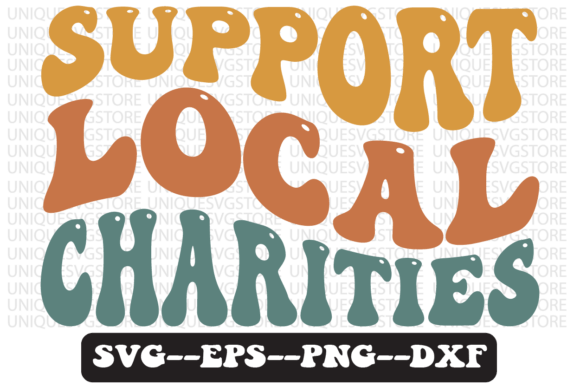
The moment I opened the file, the mood clicked: warm sepia tones, hand-drawn linework with subtle texture, slightly uneven letterforms, and a gentle vintage sunburst motif framing the phrase “Support Local Charities.” This isn’t modern-minimalist retro—it’s heartfelt retro. It evokes community bulletin boards, handmade bake sale posters, and small-town farmers’ market signage. That specificity matters. For clients in the handmade business space—think candle makers donating proceeds, ceramic studios hosting charity pop-ups, or indie bookshops running literacy drives—this design doesn’t just say “charity,” it says “we know our neighbors, we care deeply, and we do it with warmth.”
Where This SVG Design Earns Its Place in Real Projects
Support Local Charities Retro SVG Design shines brightest when used as a hero graphic or campaign anchor. I placed it front-and-center on a tote bag mockup for the client’s holiday fundraiser—and instantly elevated the perceived sincerity of the entire line. It worked equally well scaled large on a 24"x36" event poster and as a subtle watermark on thank-you cards. As a sublimation design, it held crisp detail on both light and dark hoodies in test prints. As a printable design, its clean vector paths (confirmed by inspecting the SVG layers) allowed easy color swaps in Illustrator to match the client’s existing palette—no pixelation, no jagged edges.
In digital contexts, it performed strongly across platforms: optimized PNG versions loaded fast on Instagram carousels, translated cleanly into Canva templates for volunteer coordinators, and added instant personality to Pinterest pins promoting the campaign. For Cricut users, the clean cut lines and grouped layers meant minimal prep time—ideal for crafters producing limited-run merchandise without design expertise.
Strategic Use Cases Across Client Workflows
- Product labels & packaging design: Used as a foil-stamped accent on kraft paper gift boxes—added tactile charm without overwhelming product photography.
- Social media graphics: Paired with bold sans serif body copy for contrast; the retro texture prevented visual fatigue in feed scrolling.
- Print-on-demand assets: Tested successfully on mugs, long sleeve tees, and onesies—maintained legibility and emotional resonance at all sizes.
- Editorial & blog visuals: Served as a recurring visual motif in a client’s “Meet Our Partners” blog series—creating consistency across posts without repetition fatigue.
- Sticker design & merch: Printed flawlessly on matte vinyl; the slight imperfection in the lettering made it feel human-made, not algorithmically generated.
Where Caution Is Required—Not Limitations, Just Context
This is not a universal utility asset. Its strength lies in intentionality—not versatility. I’d avoid using Support Local Charities Retro SVG Design in minimalist branding systems where restraint defines the voice, or in corporate CSR reports demanding clinical precision. At under 12px, readability suffers—the textured type isn’t engineered for micro-legibility. On busy photographic backgrounds or low-contrast substrates (e.g., heather grey sweatshirts), the subtlety of the sunburst can vanish. And while it pairs beautifully with handwritten and display fonts, it clashes with ultra-thin serifs or rigid geometric sans serifs—visual hierarchy dissolves when styles compete rather than complement.
Designer Notes You’ll Actually Use
Before clearing this for client use, I ran these checks:
- Tested black-and-white conversion: Confirmed the design retains shape and impact without color—critical for embroidery or single-color screen printing.
- Checked contrast on light/dark backgrounds: Verified minimum 4.5:1 ratio for accessibility compliance in digital deliverables.
- Previewed at multiple scales: From 2" stickers to 48" banners—no detail loss in SVG, minor softening in PNG at extreme enlargement.
- Placed on realistic mockups: Used high-res t-shirt, mug, and tote templates—not just flat previews—to assess proportion and visual weight.
- Reviewed file integrity: SVG opened cleanly in Illustrator with editable paths; PNG included alpha transparency with zero fringing.
- Confirmed commercial license: Verified explicit permission for resale items (POD, Etsy), marketing visuals, and client-branded merchandise—no attribution required.
- Font compatibility testing: Paired successfully with Montserrat (sans), Playfair Display (serif), and Pacifico (script)—but avoided pairing with ultra-light weights or monospaced fonts.
Why It Fits the Creative Marketplace—And Your Next Project
In a sea of overdesigned, trend-chasing digital product bundles, Support Local Charities Retro SVG Design stands out because it serves a clear emotional function: it makes generosity feel personal, grounded, and joyful. It supports small business branding not as decoration—but as narrative glue. Whether you’re building a design bundle for crafters, launching a printable wall art collection, or designing social media graphics for a local festival, this asset delivers authenticity on demand—without sacrificing production readiness.
For designers, marketers, and creative entrepreneurs who value both aesthetic intention and technical reliability, this isn’t just another clipart download. It’s a considered graphic design asset—one that earns its place in the final deliverable, not just the inspiration board.