Sorry About the Mess We Live Here
Let’s be real: I opened Sorry About the Mess We Live Here expecting charm—and got something sharper, more layered, and far more useful than a standard “funny quote” SVG. As someone who’s stitched hundreds of designs for Etsy shops, boutique apparel lines, and custom baby gifts, I don’t just scan files—I hold them up against real fabric, real thread, real wear. So when I pulled this into my embroidery software to prep a batch of linen tote bags for a local mom-owned shop, I paused. Not because it was complicated—but because it *worked*.
A Design That Breathes With Its Context
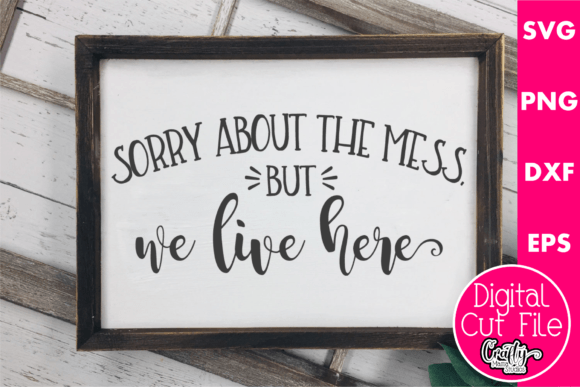
Sorry About the Mess We Live Here lands with dry wit and visual ease. The lettering is relaxed but intentional—no forced script, no over-the-top flourishes. It’s conversational, slightly slouched, and deeply human. That matters. When you’re stitching on a canvas tote or an organic cotton sweatshirt, you want text that feels like it belongs—not imposed. The spacing between words gives breath; the lowercase “i” in “live” and “here” adds quiet personality without sacrificing legibility. This isn’t a shout—it’s a wry, knowing smile stitched in thread.
Where It Shines (and Where It Needs Guardrails)
I tested Sorry About the Mess We Live Here across three real projects: a medium-weight unbleached linen tote bag (hoop size 5x7”), a soft fleece-lined baby blanket corner (3x3” hoop), and a structured cotton twill apron front (6x10”). In every case, the design held its tone—but only when matched thoughtfully to fabric, stabilizer, and purpose.
- Custom apparel & sweatshirt embroidery: Works beautifully on mid-to-heavy fabrics with light to medium stabilizer. The letterforms are wide enough to avoid stitch crowding, and the moderate stroke weight prevents fill-stitch bleed on brushed fleece or French terry.
- Tote bag design & kitchen towels: A natural fit. The phrase’s casual honesty pairs perfectly with utilitarian textiles. On tea towels, I used a subtle satin stitch outline + light fill—clean, durable, and wash-friendly.
- Baby embroidery & nursery decor: Surprisingly versatile. Stitched small (under 3”) on a muslin swaddle with pastel thread, it reads as tenderly ironic—not chaotic. Just be mindful: avoid dense fill stitches on delicate baby knits; opt for running stitch outlines or low-density fills instead.
- Embroidered patch & cap embroidery: Use caution. Curved surfaces like caps compress letter spacing, and tiny hoops (under 4”) risk losing clarity in the “o” and “e” shapes. If using for patches, confirm the file includes clean vector paths—SVG format helps, but embroidery-ready digitization is non-negotiable.
Fabric & Function: What You’ll Want to Check First
This isn’t a “drop-in-and-stitch” design if your project pushes boundaries. Here’s what I watched closely:
- Thin or stretchy fabric? Add cutaway stabilizer underneath and tear-away on top. Without it, the relaxed letter spacing can distort under tension.
- Dark fabric? Test thread contrast early. Light gray or oatmeal thread reads softer than stark white—and keeps the sarcasm grounded, not shouty.
- Layered garments (like hoodies with pockets)? Measure clearance. The full phrase stretches ~4.2” wide at standard scaling—tight near seams or zippers.
- Frequent washing? Avoid heavy satin stitch on high-wear zones. A balanced mix of fill and running stitch holds up better on towels, aprons, and kids’ items.
What It Does for Your Craft Business
As an Etsy seller and small shop product developer, I judge designs not just by how they stitch—but by how they sell. Sorry About the Mess We Live Here builds trust quickly. It signals authenticity, relatability, and craft intention—not generic clip art. Customers recognize the voice. They see themselves in it. That translates directly to higher perceived value on handmade products and stronger repeat engagement.
For digital product sellers: this phrase works well in printable mockups and social previews—especially when styled with neutral backgrounds and natural lighting. It’s recognizable at thumbnail size, and the rhythm of the line invites cropping for Instagram carousels or Etsy listing banners.
But here’s the quiet truth: sarcasm in stitch form walks a fine line. Too tight = snarky. Too loose = sloppy. Sorry About the Mess We Live Here lands in the sweet spot—confident, unhurried, and unmistakably handmade.
Practical Designer Notes Before You Stitch
Before sending Sorry About the Mess We Live Here to your machine, do these five things:
- Test on scrap fabric *with your exact stabilizer and thread*. Linen behaves differently than cotton duck—and your customer won’t know (or care) about the nuance.
- Check stitch density in the lowercase letters. Overly dense fills in small “a” or “e” shapes can pucker thin weaves.
- Confirm hoop size compatibility. If you’re working with a 4x4” hoop, scale down carefully—or crop the phrase to “Mess We Live Here” for tighter applications.
- Review licensing. This is a digital download SVG file—ideal for Cricut cutting, but for machine embroidery, you’ll need to digitize it properly or verify it’s provided as a ready-to-embroider format (PES, DST, etc.). Don’t assume.
- Preview in black and white. Does it retain character on dark fabric? Does it disappear on busy prints? Simplicity is its strength—don’t undermine it with poor contrast.
In the end, Sorry About the Mess We Live Here isn’t just another funny quote SVG. It’s a quiet piece of design empathy—crafted for real hands, real homes, and real people who’d rather laugh than apologize. Whether you’re stitching it onto a holiday gift for a new parent, branding a small-batch craft business, or building a collection of embroidered graphics for digital resale, treat it like the considered asset it is. Not filler. Not trend-chasing. Just honest, wearable, stitchable humanity.