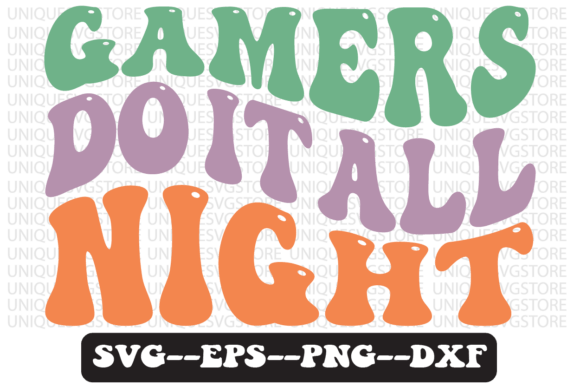
Gamers Do It All Night: Retro SVG Graphics for Crafts
As a graphic designer who’s built brand identities for indie game shops, launched print-on-demand apparel lines, and crafted seasonal merch for local gaming conventions, I recently evaluated Gamers Do It All Night Retro Svg Design for a real client project: a limited-edition “Retro Game Night” collection for a handmade business selling custom hoodies, enamel pins, and printable wall art. My goal wasn’t just to see if it looked cool—it was to assess whether it functioned as a reliable, versatile, and commercially sound graphic design asset.
First Impression: Nostalgia with Intentional Grit
The moment I opened the file, I felt the punch of authentic 8-bit energy—bold outlines, slightly uneven letterforms, and that unmistakable CRT-screen warmth baked into the color palette. This isn’t generic “vintage” styling; it’s a deliberate Video Games quote retro Svg Design rooted in early ’90s arcade flyers and bedroom-zine aesthetics. The kerning leans playful, not sloppy. The spacing invites rhythm—not chaos. That distinction matters. For a client targeting Gen Z collectors and millennial nostalgia buyers, this mood lands with emotional precision.
Where It Shines: Real-World Design Applications
In mockups, Gamers Do It All Night Retro Svg Design excels where personality and thematic cohesion outweigh minimalism. It works powerfully as:
- Hero graphics on Shopify banners or Instagram story highlights—especially against dark gradients or textured paper backgrounds;
- Product mockups for t-shirts, hoodies, and sweatshirts (the vector scalability ensures crispness at any size);
- Sticker design and enamel pin concepts—its bold silhouette reads instantly at 2 inches;
- Printable design assets for Etsy listings, including themed party kits and digital wall art bundles;
- Cricut project foundations—clean SVG paths cut precisely, with grouped layers that simplify color separation for sublimation or vinyl;
- Social media graphics for TikTok promos or Pinterest pins—its high-contrast structure survives compression and thumbnail scaling;
- Packaging design accents on mailer boxes or hang tags, adding tactile charm without overwhelming product photography.
It also strengthens brand identity systems built around community, playfulness, and analog-digital hybrid culture—think small business branding for board game cafés, indie dev merch lines, or comic-con pop-up vendors.
Where to Use It Thoughtfully
This isn’t a universal utility asset. Its expressive texture demands context. Avoid using Gamers Do It All Night Retro Svg Design in:
- Logo design unless the full brand system embraces maximalist retro—its density competes with fine typography and reduces scalability for app icons or favicons;
- Minimalist packaging design or corporate-facing materials (e.g., investor decks, B2B pitch decks), where visual trust hinges on restraint;
- Crowded layouts—like multi-product flyers—where its energy can muddy hierarchy;
- Small UI elements (buttons, favicons, notification badges) without simplification or alternate versions;
- Low-contrast backgrounds, especially light grays or pastels—test rigorously, as some screen-printed ink simulations lose legibility.
Design Performance: Hierarchy, Trust & Audience Resonance
Readability stays strong at medium-to-large sizes thanks to generous letter spacing and weight contrast—but shrink it below 48px, and the retro “glitch” effect begins to blur meaning. That’s intentional, not flawed. It trades precision for vibe, which is exactly why it connects so well with its audience: gamers, collectors, and creatives who value authenticity over polish.
For marketing visuals, it boosts engagement by triggering instant recognition—no explanation needed. In editorial design or blog headers, it signals tone before a single word is read. And for print-on-demand sellers, its commercial license clarity (confirm this before use!) means no legal friction when scaling across platforms like Redbubble or Printful.
Practical Designer Notes Before Client Deployment
Before dropping Gamers Do It All Night Retro Svg Design into a live project, I always run these checks:
- Test in black and white—does the shape hold up without color cues? (It does—solid outline integrity.)
- Preview on both light and dark backgrounds, including textured substrates (kraft paper, heather grey fabric).
- Scale it down to 32px and up to 2000px—verify SVG path smoothness and PNG transparency edge fidelity.
- Place it on realistic product mockups, not just white backgrounds—hoodie fabric grain, ceramic mug curves, and sticker die-cut edges change perception.
- Test print quality on actual garment blanks—some sublimation printers mute saturated reds; adjust CMYK profiles if needed.
- Inspect layer naming and grouping in the SVG—clean organization saves hours during Cricut or Illustrator edits.
- Compare pairing options: it sings with chunky sans-serifs (like Orbitron or Press Start 2P), nods respectfully to retro scripts, but clashes with delicate serifs or ultra-thin displays.
- Confirm commercial license scope—especially for resale in Etsy product bundles or Canva template libraries.
Final Verdict: A High-Value Creative Asset for Themed Projects
Gamers Do It All Night Retro Svg Design isn’t background filler—it’s a creative design catalyst. When your client needs to evoke late-night LAN parties, pixel-perfect passion, or the tactile joy of a well-worn controller, this SVG design delivers mood, memorability, and execution-ready flexibility. Paired with smart layout decisions and thoughtful typography, it elevates everything from a single t-shirt design to an entire handmade business campaign. Just remember: great design assets don’t replace strategy—they amplify it. Use this one where energy, authenticity, and audience resonance matter most.